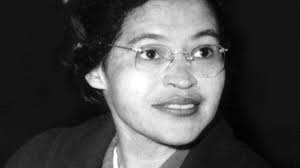
Rosa Parks was born Rosa McCauley on February 4, 1913, in Tuskegee, Alabama. Her happy parents had no idea that tiny Rosa would one day change history.
Rosa grew up in her Grandparents home in Pine Level, Alabama. Her father, a carpenter, left the family when Rosa was young. Her mother taught school a few miles away and came home on weekends.
Map showing Pine Level, Alabama
Rosa enjoyed living with her grandparents. Rosa's grandmother taught her to cook, plant and harvest their garden and sew. Her grandfather took her fishing, told her stories, and taught Rosa to stand up for herself. "I was a person with dignity and self-respect," Rosa said. "My grandfather was the one who instilled in my mother and her sisters, and in their children, that you don't put up with bad treatment from anybody."
Rosa went to school when she was 6. Her school was only for African American children. Black and white children could not go to the same school when Rosa was growing up in Alabama. The schools were separate, and not equal.
Rosa's school had only room for about 60 students. There were no desks, and only a few used books. The windows had no glass. It was hard to do work in such a crowded room, with so few supplies, so Rosa learned many lessons outside of school. She learned there were laws that kept African Americans and white people apart. Black people could not sit in restaurants with white people. Black children could not play in parks or swim in pools with white children. There were "white only" and "Colored-only" water fountains.
Drinking fountains for white people and black people
Rosa belived everyone was equal. she knew the laws that were keeping black and white people"seperate but equal" were wrong. Rosa hoped someday these laws would change.
When Rosa was in eleventh grade, her grandmother got sick. Rosa really wanted to finish high school. She wanted to become a teacher like her mother. But Rosa made a difficult choice and left school to take care of her grandmother. She also worked on her grandparents farm, sewed shirts, and cleaned the homes of white people.
Rosa met Raymond Parks when she was 19. His friends called him Parks. Soon Rosa was calling him Parks, too. Rosa liked him because "Parks belived in being a man and expected to be treated as a man."
Rosa married Parks in 1932. She now went by Rosa Parks, a name that would echo in history. Rosa and PArks lived in Montgomery, Alabama. Rosa finished high school. But Rosa couldn't find a teaching job, so she sewed clothes at the Montgomery fair department store.
Rosa's sewing machine
Rosa rode the bus to work and back home again. Each time she got on the bus, Rosa paid her dime and took a seat in the back where the law said African Americans had to sit. Rosa knew this law was wrong, but she and other African Americans felt helpless. Each bus driver carried a gun to enforce the law.
On December 1, 1955, Rosa had been working hard at her job all day. Christmas was coming and the store was busy. After work, Rosa shopped and thought about the meeting she had planned for that evening. When her bus pulled up, Rosa paid her dime and took her seat near the back of the bus.
More people got on the bus and soon it was crowded. A white man got on and saw that there were no empty seats. The bus driver told Rosa to stand up and give the white man her seat.
Rosa was tired from working all day. But Rosa Parks was also tired of putting up with the unfair treatment of African Americans. Rosa said, "I was just plain tired. It was time for someone to stand up or in my case, sit down. I refused to move." The angry bus driver called the police. Rosa was taken to jail. Later that night, her friends got Rosa out of jail. Rosa was told she must go to court on Monday, December 5.
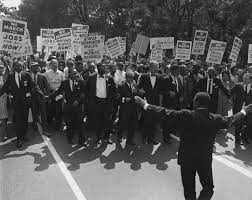
Many people in the African American community heard about Rosa's heroic stand. They decided to stop riding the buses until the law changed so that black people did not have to sit in the back of the bus or give up their seats to white people. A young preacher named Martin Luther King, Jr., helped lead this bus boycott. For the next 381 days, African Americans walked, biked, or rode wagons to work. They carpooled. Soon the buses stopped running because they had so few customers.
Finally, in December 1956, the united states supreme court ordered that the buses be fully integrated. No longer would African Americans have to give up their seats to white people or sit in the back of the bus.
Martin Luther king, Jr's leadership propelled him to the front of the civil rights movement. But it was shy, quiet, determined Rosa PArks who had the courage to stand up against the unfair laws. Rosa's heroic decision to stay seated on the bus that day changed history.