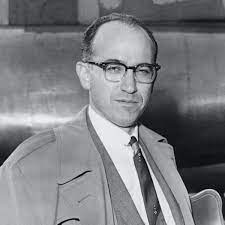
Jonas Salk was born on October 28, 1914. In New York City. In 1916, when Jonas was not yet 2 years old, American Parents grew very worried about a disease called polio. Polio attacks a person's muscles, Making walking, and even breathing difficult and dangerous. That year, over 9,000 people had polio in New York City. 2,500 polio victims died.
The Salk's were worried because polio seemed to strike children more often than adults. Most polio victims in New York City were under 5 years old. The Salk's certainly did not want young Jonas to catch polio.
Doctors knew that a virus caused polio. But no one knew how to stop the polio virus from spreading. Mrs. Salk was determined to keep polio out of her home. She made certain Jonas was very clean. She rinsed his mouth and nose with salt and water. She fed her family a balanced diet. And, She limited their servings of meat and sugar, since these foods were thought to make people more susceptible to disease. She also kept Jonas Away from other children, who might have carried the dreaded polio virus. Jonas Salk was lucky. HE didn't get polio. And one day, Jonas would help eliminate the polio virus that had harmed so many people. Jonas studied hard in school and spent his spare time reading. Jonas worked so hard that he went to high school when he was only 12 years old. HE finished high school when he was 15 and went to college. At first, Jonas thought he might become a Lawyer, but he changed his mind and decided to become a doctor.
A balanced meal
In medical school, Jonas enjoyed researching about diseases, so he chose to become a medical researcher. Instead of helping to cure someone who already had a disease, Jonas would try to stop the disease from harming more people.
In 1938, A fundraising campaign called the march of dimes began to raise money to fight polio. research doctors needed laboratories and equipment to use in their search to find a way to stop polio. Dimes were mailed to the white house because president Roosevelt himself was a victim of polio. Dimes were collected in buckets at movie theatres. Contests were held to see which communities could raise more money.
A girl holding the march of dimes fundraising can
"how many dimes in a mile?" radio stations asked it took 90,000 dimes, worth 9,000 dollars, to make a mile of dimes. People lined up dimes along miles of their local sidewalks. In 1938 alone, the march of dimes raised almost 2 million dollars. More than 50 laboratories and universities joined the effort to cure polio.
Doctor Jonas Salk graduated from medical school in 1939. At first he worked on a vaccine to stop the flu. He hadn't focused his attention on polio yet. But in 1950, Jonas, now head of a lab at the university of Pittsburg, Pennsylvania, decided to join the battle against polio. He pushed hard to obtain grant money so that he could work more directly on the polio vaccine.
Jonas knew there were 3 types of polio viruses. He also understood that every day our white blood cells battle against germs and infections that might harm us. Jonas's idea was to kill each type of virus to make his vaccine he thought that if a person was injected with a bit of dead virus, his or her body would start to fight back. During the fight against the virus, the body would build up the white blood cells it needed to fight a living polio virus. if doctor Salk's idea would worked, people who had the polio vaccine would be immune to polio.
Less than 2 years after Jonas got his grant money, he had a vaccine that protected monkeys against polio. The big question now was, would his vaccine work to protect humans? Jonas did not want too many people to know about his work. He did not want parents to get their hopes up about a polio vaccine that could protect their children.
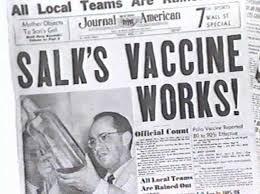
Soon, Jonas began testing his vaccine on people. He gave them his polio shots. He ran tests on their blood to see if they were protected against polio. And they were! Jonas was now so sure of his polio vaccine that he gave the shots to himself, his wife, and their 3 sons. Before long, other people heard about Jonas's discovery. Americans everywhere wanted the vaccine for their children. But first, Jonas and other doctors tested more children. The vaccine worked on almost all the children! One newspaper headline read, "SALK'S VACCINE WORKS!"
Not everyone agreed that Jonas's polio vaccine was the best was to stop polio. Other methods were tried, and they worked, too. But over the years, Jonas's vaccine proved to be the best solution.
Jonas turned his attention to other diseases at his new research center, the Salk Institute for Biological Studies. There, he and other researchers made important discoveries about diseases. To honor his heroic efforts, Jonas's words were carved into stone at the Salk Institute: "Hope lies in dreams, in imagination, and in the courage of those who dare to make dreams into reality."
Salk institute
Jonas's dream of conquering polio came true. Today, there are only about 1 to 2,000 new cases of polio worldwide each year. Maybe one day there will be none.